

Table of Contents
This is a question that has been asked more as players experiment with different sounds. Can you put bass strings on a guitar? There is more than one reason a person would want to perform this type of modification.
But can it handle this mod, and will it even sound good? These two types are radically different in both sound and performance. So will it work?
Yes, it’s possible to put bass strings on a guitar. There are modifications required to make them work correctly. Which might not be worth the effort in the end. And some are irreversible. The increased string tension might also be too much for some guitars, in which the neck could be damaged.
But experimentation is the best way to test a theory. And so if you are prepared to try it out with an instrument you may not care too much about, this article is for you!
Preparing an Electric Guitar for Bass Strings
One of the first things to consider is the new thickness of the strings and the nut. The grooves in the nut are sized for guitar gauges. And in some cases need to be modified even when jumping up a gauge in strings made for the actual right instrument.
Bass guitar strings will be far too thick for the grooves. So in this case, they will need to be enlarged in order to properly hold the new gauge. First, you will need to select a bass guitar set that will not be too far over the top.
Don’t go for super lows, for example, let’s take it slow and see what will work with the electric guitar. Remember, the neck will be stressed more than it is designed for. A light to medium set might be the best place to start.
Once you have your strings, enlarge the grooves in the nut to be able to hold them without being too tight.
The bridge on the electric guitar should have no issues with them. Unless you have a Floyd rose bridge type. In this case, you will need to block the system or hard tail it. Even loaded up with full spring tension, it may not work.
But if it’s a regular saddle, the bass strings should load up just fine. If not, you can always modify the holes to accept the strings.
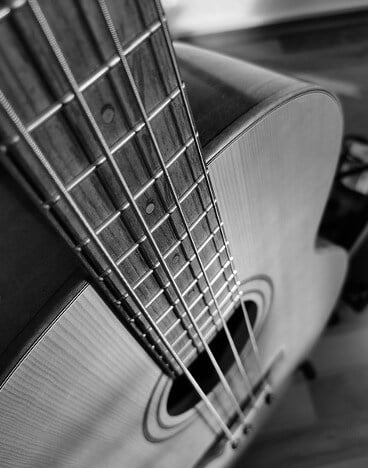
Bass String Tension
Once the strings have been put onto the guitar, you will begin to notice the neck bow as you tune. The tension of a bass string tuned to pitch will exert great force on the neck.
Some will bow badly, some will take it like a champ. Your experience will depend on the type and quality.
If yours handles them well, then you may have to increase the string height. Because the bass strings are thicker, they may end up being too close to the fretboard. If this happens, they will do nothing but buzz against the frets.
And so depending on how your guitar takes the tension, a truss rod adjustment may be necessary. Now that you have come this far, adjusting the neck to get it to play right with bass strings is a must.
Making a Guitar Sound Good with Bass Strings
There have been some players who have done this mod and have had mixed results. Some people have had the guitar hold up to the string tension just fine and were able to play it like a bass. Others have had poor results and have ended up with bad sound quality.
I believe that it has a lot to do with your expectations and the string thickness you choose. If you are looking to put this type on the guitar and play low deep chords for a metal music rhythm, this may end poorly. You might be better off seeking out an 8-string model that can be dropped way down.
If you are going to play it like a bass guitar with say lighter strings, you will probably have better results. Then there is always the scale length of the guitar and the quality of the instrument as well. If it was poor, to begin with, then it’s not right to have high hopes. This is an experiment, after all!
Possible Intonation Issues
Another issue that might surface, is the fact that the scale length is much smaller than the bass guitar. Your standard guitar is roughly 25 inches in length, while the bass is much longer. As you tune the strings to pitch, you might notice that it sounds out at certain points along the fret board.
While this would be more evident with chords, it also really depends on the guitar itself and its set up. Some people have had no issues with tuning, while others couldn’t get this mod to work because of it.
Will Bass Strings Bend the Guitar’s Neck?
Another concern is that the higher tension of the bass strings could bend the neck. This depends again on the thickness you choose and what you are tuning the guitar to. If you have selected a really heavy gauge and plan to tune it up to pitch, it may be overloaded.
It’s possible that over time, with temperature and humidity changes, the neck will warp.
Yet, if light or medium strings were put on it, you should be ok. This depends on the guitar though and how much tension it can take safely. The concern for neck damage is over the long term, not right away. It’s the changes in the environment over time that eventually does the damage.
Can You Put Bass Strings on an Acoustic Guitar?
In the case of bass strings on an acoustic, this would be the place to draw the line. An acoustic guitar would be damaged pretty well immediately. You would have issues getting this string type through the bridge. Which would require drilling.
If you were to proceed with the modification, the body and neck can’t handle the tension. So when it comes to putting them on an acoustic guitar, I would have to suggest against it. Unless you are willing to destroy the acoustic guitar.
Can You Put Bass Strings On a Guitar?
Yes, and it should work out pretty well if you go at it with the right gauge and expectations. But to be clear, we are referring to an electric guitar. Or at least a body and neck that could handle the tension. An acoustic guitar would crumble under the force and shouldn’t be attempted.
But in all honesty, if you are looking to play the bass guitar, you would be better off just going and getting a real one. The scale length of the real deal will allow you to get better sounds and note performance. The guitar will limit the accuracy of the note and probably sound out of tune at certain frets.
Bass guitars are easy to come by as they are very common. So for a better experience, just grab a used one to mess with. You will be much happier and no instruments will need to get hurt!
