If you have ever sat in a ukulele circle or browsed a forum, you have likely encountered the unspoken dogma: “Real ukulele players don’t use picks.” It is a sentiment that makes many beginners feel like they are “cheating” or failing before they even strum their first chord.
Here is the truth: You do not need a pick to play the ukulele, but using one is not wrong.
While the ukulele is traditionally a fingerstyle instrument rooted in Hawaiian culture, the choice to use a plectrum (pick) is a valid stylistic decision. It depends entirely on the sound you want to achieve, your physical comfort, and your musical background.
Whether you are a guitarist transitioning to the uke, a player dealing with arthritis, or a soloist looking for a crisp, bright attack, the pick is just another tool in your arsenal.
This guide will walk you through the nuances of pick usage, the critical differences between felt and plastic, and how to use one without damaging your instrument’s delicate soundboard.
Key Takeaways
- You do not strictly need a pick to play ukulele; traditional playing uses fingers for a warm tone.
- Using a pick is not ‘cheating’, it is a stylistic choice for louder volume, faster tremolo picking, or players with dexterity issues.
- Avoid standard plastic guitar picks as they produce a harsh ‘clicking’ sound and can damage nylon strings.
- The industry standard for ukuleles is the Felt Plectrum (compressed wool) or leather, which mimics the soft attack of a thumb.
- Ukuleles typically lack pickguards (scratch plates), so pick users must be careful not to scratch the soundboard.
- If you want a brighter sound or play ‘banjolele’ styles, use a very thin nylon pick (under 0.60mm).
Who This Is For / Who Should Skip This
This guide is specifically written for:
- Former Guitarists: Players accustomed to holding a plectrum who feel clumsy using only their fingers.
- Players with Dexterity Issues: Individuals suffering from arthritis, tendonitis, or nerve damage who find repetitive finger motion painful.
- Soloists and Leads: Musicians who need higher volume (projection) to cut through a mix of other instruments.
- Tone Seekers: Players looking for a brighter, snappier “attack” or a specific Tremolo speed that fingers cannot easily replicate.
You might want to skip this if:
- You are a Traditional “Purist”: If your goal is to master authentic Hawaiian strumming patterns (like the complex triplet strum), a pick will hinder your progress.
- You play strictly Nylon-String Classical style: If you are learning PIMA fingerpicking patterns, using a pick will limit your ability to play polyphonic (multi-voice) arrangements.
Do You Need a Pick to Play Ukulele? The Short Answer
Is it ‘Cheating’ to Use a Pick?
Absolutely not. The idea that using a pick is “cheating” is a myth. While it is true that the ukulele is traditionally played with the fingers (specifically the flesh of the thumb and the nail of the index finger), using a pick does not make you a lesser musician.
Think of it this way: Using a pick is simply a trade-off. You gain volume, speed, and definition, but you sacrifice the ability to perform complex, multi-finger strumming patterns like the “fan strum” or “clawhammer” style.
The Tradition of Fingerstyle and the ‘Purist’ Approach
To understand the controversy, you have to understand the instrument’s history. The ukulele descends from the Portuguese machete, and its evolution in Hawaii centered around a rhythmic, percussive style of playing.
The traditional method involves using the index finger for down-strums (striking with the nail) and the thumb for up-strums (striking with the flesh pad). This creates a warm, intimate sound profile with a soft attack (the initial sound of the note).
Purists argue that introducing a pick, especially a plastic one, strips the ukulele of this characteristic warmth, replacing it with a harsh, clicking tone. However, modern playing styles, including jazz, rock, and pop ukulele, often welcome that brightness.
Why Use a Pick? (The Benefits)
If you decide to step away from tradition, you unlock specific advantages that can solve common playing problems.
Accessibility: Helping Players with Arthritis or Soft Nails
For many, the question isn’t about tone, it’s about feasibility. Strumming with the index finger requires holding the hand in a specific curl and rotating the wrist repetitively. For players with arthritis, carpal tunnel, or limited fine motor skills, this can be painful or impossible.
A pick acts as an extension of the hand. It reduces the range of motion required to sound the strings and alleviates pressure on the joints.
Furthermore, if you have naturally soft, brittle nails that break easily against Nylon or Fluorocarbon strings, a pick ensures you get a consistent sound without shredding your fingernails.
Tone Profile: Achieving Higher Volume and ‘Crisp’ Attack
Ukuleles are naturally quiet instruments. If you are playing in a group (a “uke jam”) or accompanying a loud singer, your sound can easily get buried.
Fingers produce a mellow, rounded tone. A pick produces a sharp, high-definition tone. Because a pick is generally harder than your fingertip, it transfers more energy into the string, resulting in:
- Higher Volume: The dynamic range increases significantly.
- Clarified Note Separation: When playing arpeggios (broken chords), individual notes ring out more clearly.
- Brighter Treble: It emphasizes the high-end frequencies, making the uke sound “crisper.”
Technique: Facilitating Tremolo and Flatpicking Speed
Certain techniques are simply easier with a tool. Flatpicking, a technique borrowed from bluegrass and guitar playing, involves picking individual melody notes rapidly using alternate down-up strokes.
While advanced players can do this with their fingers, a pick makes achieving high-speed, consistent tremolo much easier. If you want to play fast melody lines or solos, a pick offers superior efficiency.
Choosing the Right Tool: Types of Ukulele Picks
This is where 90% of beginners go wrong. You cannot simply grab a standard guitar pick and expect a good result. The material of the pick interacts with the density of ukulele strings to determine the sound.
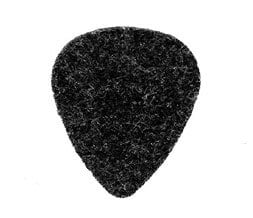
The Industry Standard: Felt Plectrums (Wool/Synthetic)
If you walk into a music store and ask for a ukulele pick, this is what you will be handed.
What it is: A thick (usually 3mm+) pick made of compressed wool or stiff synthetic felt.
The Sound: This is the closest you can get to the sound of a thumb. The soft texture absorbs the high-pitched “click” of the impact, leaving only the warm tone of the vibrating string.
Best For: Strumming chords, accompaniment, and players who want to use a pick without “sounding” like they are using a pick.
Note: Felt picks soften over time and can become “fuzzy,” requiring replacement more often than plastic.
The Soloist’s Choice: Leather Picks
What it is: A piece of hardened, often tanned leather.
The Sound: Leather occupies the middle ground. It is harder than felt but softer than plastic. It produces a louder sound than felt but maintains a woody, organic tone.
Best For: Hybrid players who switch between strumming and picking individual melody lines.
The Flatpicker’s Choice: Thin Nylon/Fluorocarbon Picks
What it is: Very thin, flexible guitar picks (usually 0.38mm to 0.50mm).
The Sound: Bright, percussive, and snappy.
Best For: Rock, Pop, or Banjo-Ukulele (Banjolele) players.
Warning: You must choose a thin gauge. Thick, rigid guitar picks will overpower the ukulele’s small body and sound harsh.
Why You Should Avoid Standard Plastic Guitar Picks
Standard medium-to-hard guitar picks (0.73mm and above) are generally considered poor choices for the ukulele for two reasons:
- The “Click”: Plastic hitting plastic (or nylgut) creates a high-pitched transient noise that can be louder than the note itself.
- The Tension Mismatch: Ukulele strings are under much lower tension than steel guitar strings. A hard pick creates too much resistance, causing the strings to flap wildly and go out of tune (pitch drift) upon attack.
Technique Guide: Using a Pick Without Damage
Transitioning to a pick requires adjusting your mechanics. The ukulele is physically more fragile than a guitar, and bad technique can lead to cosmetic damage.
Protecting the Soundboard (The Lack of Pickguards)
Look at a steel-string acoustic guitar; it has a plastic pickguard (or scratch plate) glued next to the soundhole. Most ukuleles do not. The wood of the soundboard (top) is often thin cedar, spruce, or mahogany.
If you strum wildly with a pick, you run the risk of the “Willie Nelson Effect”, digging a hole right through the finish and into the wood.
The Fix: Control your strumming arc. Focus on wrist rotation rather than elbow movement. Keep your strumming hand floating slightly further away from the body than you would with fingerstyle.
Avoiding the ‘Click’: Angle and Grip Adjustments
To minimize the dreaded plastic clicking noise (if you aren’t using felt):
1. Angle the Pick: Do not strike the string with the pick flat (parallel) to the string. Angle the leading edge slightly so it glides over the string rather than slapping it.
2. Use the Shoulder: Instead of using the pointy tip of a teardrop pick, rotate it and play with one of the rounded “shoulders.” This presents a broader surface area, smoothing out the tone.
3. Relax the Grip: A death grip on the pick makes it act like a rigid lever. Loosen your grip to let the pick flex as it passes over the strings.
Finding the Strumming Sweet Spot
On a guitar, you typically strum over the soundhole. On a ukulele, the “Sweet Spot” is often slightly higher, where the neck meets the body.
Why? The strings have more tension here and move less side-to-side. This allows for cleaner pick articulation and reduces the chance of the pick digging too deep into the strings (which causes snagging).
Troubleshooting Common Issues
Even with the right pick, you may encounter these hurdles.
Dealing with ‘Flying Picks’ (Grip Issues with Felt)
Felt picks are thick and can be slippery, leading to them flying out of your hand during vigorous strumming.
The Solution: Look for felt picks with a cutout hole in the center. This allows your thumb and index finger flesh to touch, locking the pick in place. Alternatively, you can apply a small piece of grip tape or “gorilla snot” (a sticky grip aid for musicians) to the felt.
Preventing String Shredding on Wound Low-G Strings
If you play a Tenor or Baritone ukulele with a Wound Low-G string (a nylon core wrapped in metal wire), be careful.
- The Issue: A hard plastic pick can act like a saw against the metal windings of the string, causing them to fray or snap prematurely. Conversely, the rough wound string can file down your felt pick, creating dust.
- The Solution: If you use a wound Low-G, a leather pick is your best compromise for durability and tone.
The ‘Willie Nelson Effect’: Scratching the Finish
If you notice small scratches appearing above or below your soundhole, stop immediately.
The Solution: If you cannot adjust your technique to avoid hitting the body, install a clear, static-cling pickguard. These are removable, transparent sheets that protect the finish without altering the look of the instrument.
Frequently Asked Questions
Can I use a regular guitar pick on a ukulele?
Yes, but with caveats. Standard guitar picks are usually made of celluloid or tortex and are designed for high-tension steel strings. On a ukulele, they produce a “clicky” sound. If you must use a guitar pick, choose the thinnest gauge available (under 0.50mm) and play with the rounded shoulder of the pick, not the sharp tip.
Does using a pick damage ukulele strings?
It can. Hard plastic picks can create divots in softer Nylgut strings over time, shortening their lifespan. They can also strip the winding off of metal-wound Low-G strings. Felt and leather picks are much safer for ukulele strings and generally cause no more wear than human fingernails.
Is it harder to play with a pick or fingers?
It depends on the style. Simple down-up strumming is often easier with a pick for beginners. However, advanced ukulele techniques like the “triple strum,” “fan strum,” or “split stroke” are designed for the mechanics of the hand and are significantly harder, if not impossible, to replicate with a pick.
Can I use a Thumb Pick on a ukulele?
Yes. Thumb picks are popular among banjo-ukulele players and fingerstyle players who want a strong bass response while keeping their other fingers free to pluck the treble strings. This is a common setup for “Travis picking” patterns on the ukulele.