
Table of Contents
Fender and Vox are arguably the most well-known amplifier manufacturers in history. Their sounds are present on thousands of records. This is because they’ve influenced guitarists for decades.
When it comes to their differences, Fender is generally known for its bright, clean sound. Vox is known for its chime and jangly sound due to the absence of negative feedback on its designs.
You might be inclined towards Fender or Vox amps, depending on your needs and preferences.
To help you in making a better decision, this Killer Rig article features a quick comparison. It’s based on their sound, music style, design, and price.
History of Fender and Vox Amps
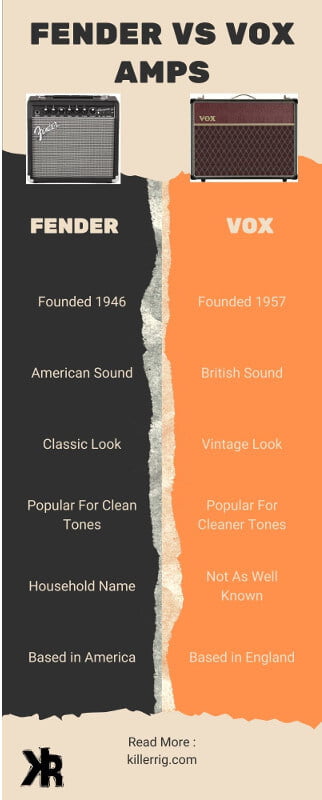
The Fender Musical Instruments Corporation was founded in Fullerton, California in 1946. The company began as a manufacturer of electric guitars and basses.
Specifically for musicians looking for an alternative to Gibson or Rickenbacker instruments. The Fender Bassman was introduced in 1952. It remains one of the most iconic guitar amplifiers today.
Vox is a British company that specializes in making guitar amps. They do make other musical equipment as well. Vox was founded in 1957 by Thomas Walter Jennings, who chose the company name from the Latin word for voice.
Vox’s first big success came in 1958 when it introduced its most iconic electric guitar amp, the AC30. This amp was extremely popular among British musicians.
This is because of its chime and high-end tone. It was also the primary sound of the early recordings from The Beatles.
Differences Between Fender vs Vox Amps
If you’re not sure whether to go with a Fender or a Vox amp, here are the main differences between them:
- Fender amps are known for their bright, clean sound, Vox is famous for their chime and jangle.
- Most Vox amps are not designed with a negative feedback circuit. This gives them their desired sound.
- Fender amplifiers tend to be cheaper than Vox models.
- Both have slightly different looks and aesthetics.
- Both brands offer a wide range of solid-state and tube models.
Signature Sound
Fender amps are known for their bright, clean sound, and are excellent for a wide variety of genres. Their amplifiers will give you a very scooped sound. Also with lots of bass and treble that goes into overdrive well.
Fender amps also have tremolo and spring reverb features. This gives them a rich texture in addition to their signature clear overdrive tones.
Fender’s bright, high-headroom clean tones work great with any genre. All without needing any pedals or extra equipment.
This makes them perfect for studio recording when distortion isn’t wanted. But still offers interesting textures for layering with other instruments.
If you’re building a guitar tone inspired by the British invasion, look no further than Vox amps. Their amplifiers also have a specific sound. This is largely due to the absence of negative feedback.
Adding negative feedback is a more American design principle. It reduces gain in the power amplifier. Vox achieves added gain and a highly sensitive, touch-responsive amplifier. This is because they do not use this design.
The reverb and tremolo complete the trademark jangle. It made artists like The Beatles stand out from their competitors. Especially during the British Invasion.
Music Styles
If you’re looking for a heavily distorted tone, Vox is the way to go. Vox amps are known for producing heavy and crunchy distortion. It sounds great on rock music. Their amps are good for bands who want to sound like The Beatles or The Rolling Stones.
On the other hand, Fender amps are more famous for their clean sound, clarity, and versatility. These amps work best with blues, jazz, and country music. The Fender Blues Junior is a great example of this type of amp.
Designs
When it comes to aesthetics, the Fender design is conservative and traditional-looking. All with a rectangular front and back panel. They have a classic black-and-white color scheme. It’s a retro styling that revisits the 1950s.
The Vox design is more modern and innovative. With a custom diamond-shaped grille in front. Vox amplifiers were originally created with a more conservative TV-front look. This design was abandoned for a different look. It has remained largely unchanged since 1960.
While both amps are designed to look classic or vintage, they are very much different. But the thing is, each one can look the part with ease and so when it comes to aesthetics, you are pretty much covered.
This lets you focus more on the number of channels they have and whether you want tube or solid-state.
Price Range
Vox amps are typically more expensive than Fender models. But this doesn’t mean that their products are cheap by any means. Fender also offers a more diverse lineup of products. Ranging from solid-state amps to valve models.
Another thing to take into consideration is whether a product is hand wired or not. This will also greatly affect the price.
Solid State Model Comparison
| Model | Wattage | Price |
|---|---|---|
| Fender Frontman 10G | 10W | $99.99 |
| Vox Pathfinder 10 | 10W | $109.99 |
| Fender Champion 20 | 20W | $149.99 |
| Vox VT20X | 20W | $279.99 |
| Fender Acoustasonic | 40W | $249.99 |
| Vox VT40X | 40W | $349.99 |
| Fender Mustang | 50W | $279.99 |
| Vox Cambridge | 50W | $399.99 |
Tube Model Comparison
| Model | Wattage | Price |
|---|---|---|
| Fender Bassbreaker 007 | 7W | $549.99 |
| Vox AC10C1 | 10W | $579.99 |
| Fender Bassbreaker 15 | 15W | $749.99 |
| Vox AC15C1 | 15W | $799.99 |
| Fender Bassbreaker 30R | 30W | $1099.99 |
| Vox AC30C2 | 30W | $1299.99 |
| Fender Hot Rod Deluxe IV | 40W | $999.99 |
| Fender Blues Deluxe | 40W | $999.99 |
Check out our guide for Best Guitar Amps under $500 here.
Fender vs Vox Amps: Which One Is Better?
Each amp has its own set of features that make it more or less suited to a certain kind of music. In this case, choosing the better amp largely depends on your preference as a player.
Why Choose Fender Amps?
If you prefer a clean and crisp tone, choose a Fender amplifier. Fender amps are the best for rock, blues, and country music because of their clean tone.
For a long time, people criticized Fender for not having enough gain. Especially when compared to their peers at Vox and Marshall.
Now, everyone agrees that their clean sounds are definitely up there with the best of them! Crystal clear and warm, exactly what you’d want from your amp. Especially if you are working on your finger-picking skills.
Why Choose Vox Amps?
If you’re looking for a model with an aggressive distortion tone, then choose a Vox amplifier. The signature tone of Vox is unique. Their amps are known for their British sound, which can be heard in many classic rock songs.
Vox amps are also great for rock, pop, and jazz. And pretty much anything else you can imagine playing on an electric guitar.
Conclusion
As you’ve learned, both are quality brands! They produce great amplifiers for electric guitars. Now that you’ve got a good sense of what each brand has to offer. The next step is to figure out what’s most important to you. Tone, music style, design, or price?
Hopefully, this guide has given you all the information needed to choose which one is right for you. Will it be Fender or Vox? The choice is yours.
